
Capital Investment Acceleration: Mitigating Telemetry & Control Loop Risks in UK Water & Wastewater Infrastructure
The UK water and wastewater sector is executing the most intensive infrastructure modernization program in its history. As water companies advance their £88 billion Asset Management Period 8 (AMP8) capital delivery frameworks, supported by recent Ofwat regulatory investment decisions and regional capital expenditure programs exceeding £2 billion annually, the sector is under relentless pressure to improve operational resilience, eliminate environmental spillage, and expand network capacity.
From extensive storm overflow monitoring and phosphorus removal upgrades to automated chemical dosing and sludge treatment expansion, water utilities and their Tier 1 engineering contractors are deploying thousands of new field sensors, flowmeters, and level transmitters.
However, scaling up sensor density across aging water treatment works (WTWs) and wastewater treatment works (WwTWs) exposes control networks to severe signal corruption, ground loops, and component obsolescence. For control system integrators, instrumentation engineers, and panel builders, maintaining unwavering 4-20mA signal integrity across these expanding telemetry networks is non-negotiable.

Technical Challenges in Water & Wastewater Control Loops
Water treatment facilities present some of the most electrically hostile environments in process engineering. High-power variable speed drives (VSDs), large submerged pumps, aerators, and heavy-duty switchgear generate substantial electromagnetic interference (EMI) and transient voltage spikes.
When field instrumentation is wired across long cable runs back to central Programmable Logic Controller (PLC) racks or Remote Terminal Units (RTUs), several critical technical failure modes emerge:
1. Ground Loop Current Corruptions
When field transmitters and central control cabinets share different earth ground potentials, parasitic current flows through the signal loop shield or reference conductors. In a 4-20mA current loop, even a minor ground potential difference introduces additive measurement errors, causing inaccurate chemical dosing, false level readings, or unrecorded flow spikes.
2. High Common-Mode Noise Voltages
High-power industrial equipment switching nearby induces common-mode voltage noise onto signal lines. Without adequate galvanic isolation, this noise can bypass field device filters, degrading PLC analogue-to-digital converter (ADC) accuracy or permanently damaging sensitive input cards.
3. Corrosive and Damp Operational Environments
Moisture ingress and atmospheric hydrogen sulphide ($H_2S$) in wastewater treatment plants degrade terminal connections and PCB traces over time. Unprotected or low-grade signal conditioning modules suffer premature component drift, increasing maintenance overheads and calibration frequency.
The Critical Role of Galvanic Isolation and SIL-Rated Trip Amplifiers
To guarantee uncorrupted telemetry signals between field sensors and SCADA monitoring systems, control loops must incorporate failure-safe, high-grade galvanic isolation.
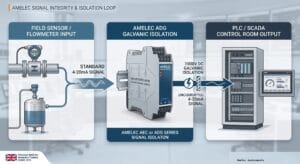
1. Complete Electrical Stage Separation
Galvanic isolators, such as the Amelec ADG Series (ultra-compact profile) and AEC Series (standard DIN-rail/plug-in configuration), physically isolate input, output, and power supply circuits up to 1000V AC/DC. By breaking the physical copper path using optical or transformer coupling, ground loops are completely eliminated, protecting sensitive telemetry equipment from transient voltage surges.
2. High-Speed Signal Splitting
In modern water treatment, a single 4-20mA field signal often needs to drive multiple independent systems, such as a local panel indicator, an environmental data logger, and a main plant SCADA system. Signal splitters (e.g., Amelec ADG231-HS) split a single input into two fully isolated, independent 4-20mA outputs without loading the primary loop or compromising response times.
3. SIL-Rated Safety Trip Amplifiers for Critical Dosing
Chemical dosing loops (e.g., sodium hypochlorite for chlorination or ferric sulphate for phosphate removal) require strict safety interlocks. Dual-output trip amplifiers (such as the Amelec AEC232) continuously monitor process parameters and provide instant, hardware-driven relay contacts for high/low alarm conditions. Certified for use in SIL 1, SIL 2, and SIL 3 safety instrumented functions, these analogue units ensure fail-safe operation even if upper-level digital controllers experience power or network loss.
Obsolescence Mitigation and Supply Chain Resilience for AMP8
With AMP8 capital delivery stretching through 2030, water utilities cannot afford long lead times or frequent component End-of-Life (EOL) revisions. Commercial off-the-shelf electronics with short 3-to-5-year product lifecycles expose water companies to expensive, unbudgeted panel redesigns.
Amelec Instruments offers a resilient, sovereign British manufacturing alternative:
50 Years of UK Manufacturing Excellence: Operating from Milton Keynes since 1975, Amelec engineers and builds heavy-duty process instrumentation tailored specifically to British industrial standards.
Exact-Fit Legacy Drop-In Support: We maintain long-term product availability, offering drop-in replacement modules for aging or discontinued signal conditioners, trip amplifiers, and transducers without requiring physical cabinet alterations.
Verified Water Sector Accreditation: Amelec holds Achilles UVDB Silver Plus registration, LRQA ISO 9001 certification, JOSCAR verification, and Cyber Essentials alignment, ensuring complete compliance with water sector procurement gateways.
Industry-Leading 10-Year Warranty: Every standard isolator, transmitter, and trip amplifier leaves our factory backed by a 10-year warranty, matching the long multi-AMP investment horizons of UK water utilities.
Ensuring Long-Term Integrity Across AMP8 Deliverables
As UK water companies scale up infrastructure spending to meet strict environmental targets, specifying robust, analogue signal conditioning is the most cost-effective insurance policy against telemetry errors, plant downtime, and premature equipment failure.
Whether retrofitting legacy control panels or designing new instrumentation enclosures for major WwTW expansions, specifying Amelec signal isolators and trip amplifiers guarantees complete signal integrity from field to control room.
Internal Linking Recommendations
"Amelec ADG Series"(https://amelec-uk.com/product-category/adg-series/)"AEC Series"(https://amelec-uk.com/product-category/aec-series/)"Achilles UVDB Silver Plus"(https://amelec-uk.com/about-us/accreditations/)