
The UK nuclear renaissance has transitioned from high-level policy into active commercial deployment. With Great British Energy – Nuclear (GBE-N) and Rolls-Royce SMR advancing contracts to deliver the UK’s first fleet of Small Modular Reactors (SMRs) at Wylfa on Ynys Môn, the civil nuclear supply chain is mobilising at scale. This project aims to deliver up to 1.4 GWe of clean, low-carbon baseload electricity, creating thousands of skilled UK manufacturing jobs.
Unlike gigawatt-scale, traditional civil-engineered nuclear stations, SMR architecture is fundamentally defined by modularity, factory-based fabrication, and repeatability. For control and instrumentation (C&I/ICA) engineers, systems integrators, and control panel builders, this shift introduces a critical technical question: How do we engineer safety instrumented loops that comply with rigorous nuclear functional safety standards while supporting standardised, high-density modular skids?
The Modular Nuclear Paradigm: Why Factory Assembly Demands Signal Fidelity
Small Modular Reactors rely heavily on off-site, skid-mounted manufacturing. Standardised modular cassettes and control enclosures are pre-wired, factory-tested, and transported to the licensed nuclear site for final integration. This methodology compresses construction timelines, but it introduces three distinct electrical and instrumentation challenges:
- High-Density Cabinet Footprints: In modular containment skids and auxiliary systems, DIN-rail space inside marshalling boxes and control panels is strictly constrained. Instrumentation cannot rely on bulky, legacy chassis-mount modules; it demands ultra-compact form factors that deliver high channel density without generating excessive parasitic heat.
- Severe Common-Mode Noise & EMI: Modular nuclear installations position heavy electrical switchgear, high-efficiency cooling loop variable speed drives (VSDs), and sensitive sensor cabling in close physical proximity. Without robust galvanic isolation, transient electromagnetic interference (EMI) and ground loops compromise sensitive 4-20mA process signals feeding reactor protection systems.
- Cyber-Physical Determinism & Firmware Immunity: While supervisory data logging and fleet telemetry increasingly adopt digital protocols, primary safety shutdown functions within a nuclear installation must remain deterministic, verifiable, and secure against cyber vulnerabilities. Discrete analogue hardware loops provide hardware-enforced logic that cannot be compromised by software bugs, unauthorized access, or firmware obsolescence.
Maintaining Analogue Loop Integrity Across SIL 1, SIL 2, and SIL 3 Architectures
For over five decades, analogue loop architecture has served as the backbone of safety-critical nuclear instrumentation. In an SMR environment, precision analogue signal conditioning—encompassing trip amplifiers, signal isolators, and signal splitters—acts as the foundational shield protecting reactor protection systems (RPS) and post-accident monitoring displays.
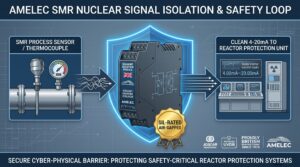
The Analogue Safety Principle: Hardware-based analogue signal conditioners deliver deterministic response times (<100ms) with zero software attack surface, making safety case certification under Office for Nuclear Regulation (ONR) guidelines clean, repeatable, and robust.
To meet the safety criteria enforced across UK nuclear platforms, signal conditioning modules specified within modular reactor auxiliary skids must address three non-negotiable operational requirements:
1. Triple Galvanic Separation
High-integrity optical and transformer isolation (minimum 1000V DC) across input, output, and auxiliary power circuits physically breaks ground paths. This suppresses earth loops and prevents destructive field faults from migrating to central safety computers.
2. Deterministic Dual-Trip Amplification
Safety interlocks monitoring coolant flow, containment pressure, or loop temperatures require instantaneous hardware switching. Dual-channel trip amplifiers (such as the Amelec AEC Series Trip Amplifiers) provide fail-safe, de-energise-to-trip relay contacts, executing hardwired emergency shutoff independently of programmable control layers.
3. High-Speed Signal Splitting
Transmitting a single critical sensor output (such as core temperature or primary loop pressure) to both local skid-mounted indicators and central monitoring rooms requires high-speed signal splitters (such as the Amelec ADG Series Splitters). These modules isolate each branch, ensuring a downstream short-circuit cannot corrupt the primary safety loop.
Sovereign Supply Chain Assurance: Amelec’s Alignment with GBE-N Procurement Goals
Great British Energy – Nuclear has reinforced that deploying the UK’s first SMR fleet requires a resilient, sovereign domestic supply chain. Relying on offshore component suppliers with volatile lead times or high obsolescence rates presents unacceptable commercial risks for modular nuclear construction timelines.
Operating from our Milton Keynes facility since 1975, Amelec Instruments provides panel builders and tier-one contractors with complete sovereign continuity:
- Pre-Qualified Sector Accreditations: Amelec is JOSCAR Registered (fully verified for nuclear and defence procurement), Achilles UVDB Silver Plus accredited, LRQA ISO 9001 certified, and Cyber Essentials aligned.
- Obsolescence Mitigation & Legacy Support: SMR platforms are engineered for operational horizons exceeding 60 years. Amelec provides long-term legacy product support, avoiding arbitrary component discontinuations and providing exact-fit replacement support.
- Industry-Leading 10-Year Warranty: Every standard isolator, transmitter, and trip amplifier leaves our UK factory backed by a 10-year warranty, providing long-term lifecycle assurance matched to nuclear asset life expectations.
- Compact & Custom Form Factors: From ultra-narrow, space-saving DIN-rail modules (ADG Series) to robust plug-in cards and rack assemblies (AEC Series), Amelec adapts form-fit-function configurations to meet the spatial constraints of compact modular reactor designs.