
Safeguarding Legacy Control Loops Amidst Fleet Life Extensions
The UK’s nuclear energy trajectory has reached a definitive turning point. With the UK government and EDF reaching an initial deal to extend the operational life of Sizewell B by 20 years through to 2055, alongside confirmed operating extensions for the Heysham 1 and Hartlepool stations out to March 2030, the nation is leaning heavily on existing atomic infrastructure to secure low-carbon baseload power. Simultaneously, the Ministry of Defence’s Defence Investment Plan (DIP) allocates over £63 billion to the Defence Nuclear Enterprise (DNE) over the four years to 2030.
While these announcements bring long-term certainty to the energy and defence sectors, they present a complex operational challenge for process control engineers, panel builders, and plant operators: how to maintain safety-critical instrumentation loops designed decades ago without incurring the extreme costs and regulatory risks of total digital system overhauls.
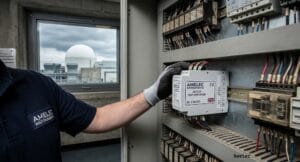
The Obsolescence Trap: Why Digital “Rip-and-Replace” Isn’t Always the Answer
Extending the operating lifespan of a nuclear facility by two additional decades creates severe component availability issues. Over time, original equipment manufacturers (OEMs) often discontinue micro-components, declare entire instrument series obsolete, or alter physical footprints, leaving control panel maintainers stranded.
Faced with component end-of-life (EOL), engineering teams often evaluate total digital control upgrades. However, in safety-critical nuclear environments, a complete digital replacement introduces significant hurdles:
Regulatory & Safety Case Recertification: Replacing proven hardware-based logic with software-driven programmable systems requires exhaustive re-validation under strict Office for Nuclear Regulation (ONR) frameworks.
Extended Outage Time: Installing new cabinet backplanes, re-cabling, and debugging software during scheduled refuelling outages risks costly generation downtime.
Cybersecurity Vectors: Microprocessor-based digital field devices introduce firmware vulnerability vectors, complicating compliance with Cyber Essentials and NIS Directive requirements.
To maintain continuous, safe generation while fulfilling life-extension mandates, plant operators must prioritize smart asset renewal—retaining existing cabinet architectures by sourcing exact-fit, high-reliability analogue instrumentation.
Preserving Analogue Integrity in Safety-Critical Instrumentation Loops
Analogue signal conditioning remains the gold standard for high-integrity Safety Instrumented Systems (SIS) within civil nuclear and defence installations. Discrete
analogue circuits deliver deterministic response times, immunity to software corruption, and transparent failure modes.
When maintaining or retrofitting 4-20mA instrumentation loops across extended operational lifespans, three technical parameters are non-negotiable:
1. Failure-Safe Galvanic Isolation
In high-density control cabinets, ground loops, voltage transients, and common-mode noise can corrupt sensor telemetry sent to central control rooms or protection systems. High-grade galvanic isolation—physically separating input, output, and power supply stages up to 1000V AC/DC—ensures signal fidelit
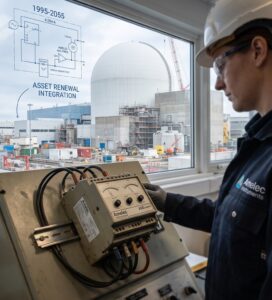
y and protects sensitive monitoring hardware from catastrophic field faults.
2. SIL 1, SIL 2, and SIL 3 Compliance
Safety Instrumented Functions (SIFs) demand predictable Probability of Failure on Demand (PFD) metrics. Trip amplifiers and signal splitters must be certified to functional safety standards (IEC 61508 / IEC 61511), allowing instrumentation engineers to calculate loop reliability with complete mathematical confidence.
3. Form-Fit-Function Drop-In Compatibility
Obsolescence mitigation requires replacement modules that match the electrical parameters, terminal configurations, and physical mounting footprints of legacy units. Replacing a failed trip amplifier should be a plug-in operation, not an enclosure re-engineering project.
How Amelec Instruments Empowers the UK Nuclear Supply Chain
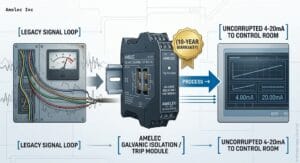 For over 50 years (established 1975), Amelec Instruments has been a trusted British manufacturer of heavy-duty, highly reliable analogue process instrumentation. As the UK scales up its nuclear asset retention and fleet life extensions, Amelec provides the supply chain security required to keep critical infrastructure operational.
Our manufacturing capabilities directly address the challenges of life-extension maintenance:
Dedicated Legacy Support: We engineer exact-fit replacements for obsolete commercial and proprietary signal conditioners, trip amplifiers (AEC & ADG Series), transmitters, and power supplies.
Sovereign UK Supply Chain Assurance: Proudly manufactured in Milton Keynes, Amelec eliminates international supply chain vulnerabilities. We hold JOSCAR Registration (verified for defence and nuclear procurement), Achilles UVDB Silver Plus, and LRQA ISO 9001 certifications.
Industry-Leading 10-Year Warranty: Every standard module that leaves our facility is backed by a 10-year warranty, providing long-term lifecycle assurance matched to the extended operational horizons of Sizewell B, Heysham 1, and Hartlepool.
Securing Your Infrastructure for the Long Haul
The lifetime extensions of the UK’s nuclear fleet demonstrate that robust analogue assets, when maintained with high-quality instrumentation, can operate safely for decades. Rather than risking expensive digital overhauls, process engineers can protect their budgets and safety cases by specifying high-integrity, British-manufactured signal conditioning.
Internal Linking Strategy
"trip amplifiers (AEC & ADG Series)"https://amelec-uk.com/product-category/aec-series/"JOSCAR Registration"https://amelec-uk.com/about-us/accreditations/"exact-fit replacements for obsolete"https://amelec-uk.com/obsolescence-support/